now he argues with me on everything
What are you giving him to argue about? It takes two to create an argument! Can you give us some examples?persistent. to say it negatively he harrasses me and i often have to separate myself from him because he won't take no for an answer 99 percent of the time.
What are you saying no to that he needs to be persistent about?He needs a lot of physical stimulation which is very draining.If he feels it's kind of random which of his needs will be met, he'll ask for way more than he needs. If he needs "10" and you say yes to 5 out of 10 requests, how many requests does he need to make to be fairly certain of getting 10? (If my math is correct, 30 requests will get pretty close to 10.)
And imagine what it's like to be bursting with that need. Imagine what it's like asking for it and being turned down. I'm not saying that to make you feel guilty. What you need is a mental shift away from thinking he needs more than you can give.He is constantly putting things in my face no matter how much i tell him not to OR climbing on my back/ shoulders any chance he gets.If someone needs three glasses of water a day and only gets two, they'll spend the rest of the day trying to get that third glass. So it will seem to others like this person's constantly thirsty and can never get enough. But if he gets three glasses and can have as many as he wants, he won't seem thirsty at all.
He can't need less by being given less. He can't modify his needs to meet what you're willing to give. He can lose faith that you'll meet his needs. He can look elsewhere to others offering to give what you won't. (It's how predators work.)
If you can mentally shift away from seeing his demands as too much to his needs being large and you as the one who is privileged with meeting them, it will help a lot.
It will also help to shift away from stuffing down your own needs to meet his. Shift to finding ways to meet his needs AND yours. His needs take precedence since he doesn't have the power to meet his own but you have the power to manipulate the world to meet his and yours.
What are you doing when he does that? It sounds like he wants your full attention. Kathryn would put her hands on my face even though I told her I didn't like it, but it was her way of saying I wasn't being present enough. I was off in my head, physically there but not mentally there.We are an only parent/ only child dynamic which intesifies things...Maybe when he does that he needs you to roughhouse with him then. Don't see it as rewarding him for doing what you don't like but as an indication that you aren't noticing early enough that he needs your attention. See the touching as his last resort to communicate with you because all the more subtle acceptable ways weren't working.
Yes, it will. It will help if you can get some older kids and adults who like physical play into his life. Team sports? Martial arts?he is totally resistant to anything to do with school. he loves harry potter: listening, reading, watching, riding bike/ scooter, watching animal documentaries, stories...
Why do you want him to be not resistant to school? What do you want school to do for you?I want advice regarding how your children learned to read. I know many children teach themselves but don't see that happening with my son...
He's still young for reading, especially for a boy. 6-10 is typical for boys. But 12, 14 isn't unusual for either sex.i no longer consider myself a pure unschooler, not since my son was 5... i had very little support in the freedom i allowed him... and did not have a partner in protection of such... and now he is older and very controlling of me and so I do have to have boundaries with him now.It will help not to think of learning to read as teaching themselves. Teaching suggests it's a simple mechanical process that kids will figure out. But if the various brain areas aren't mature enough to do their part in the decoding, he physically can't read, no matter what anyone does.
If he's in a print rich environment, if his experiences with print are positive, if there's text that's useful for what he's interested in, he will read when he can.
Freedom is probably not the best concept to raise kids by. Meeting and supporting their needs is much better.Freedom suggests doing whatever you want without regard to others. If you're there to meet his needs, you can do it in ways that are respectful of you, him and others, kind, safe and any other principles a situation calls for.
Your whole post sounds like you're gritting your teeth and putting up with him. And that's because you're in a mental place of this being more than you can handle and if he'd just need less, you could meet his needs. But he needs what he needs. That's not going to change. The only one you can change is you.
But trying harder isn't going to work! It will mean just gritting you teeth harder. You need a big mental shift away from where you are that's causing you to grit your teeth.
Joyce
When kids get sneaky, what might that signal to a parent? ...
He can...sometimes get sneaky if we've got a favorite food to
share, but we've asked that some be left in the bag for tomorrow, or
for when dad wakes up, etc.
Jenny Cyphers wrote:
He's not ready for that. Why not take out what you want to leave for dad and the next day. Do it in such a way that he never sees it. Then give him what he can eat and let him eat all of it. Don't ask him to eat part and leave part. That's clearly too hard for him to do!Joyce Fetteroll wrote:
Don't see his behavior through adult eyes. That view casts children as the bad guys when they disobey what adults want them to do. See the behavior for what it is. He has a need. He sees you as an obstacle, as someone who not only won't help him meet his need but will probably stop him. So he's avoiding the obstacle to try to meet the need himself.It's the essence of every story: The protagonist has a need. He finds ways around what stands between him and what he needs.
Rather than being an obstacle, be his partner in meeting his needs. Be the one keeping an eye on the needs of those around him as you find respectful, safe, doable ways for him to meet his needs. Be the one manipulating the environment so he's not in a situation he can't handle yet.
Joyce
(on the Always Learning list, August 2011 here)
"How will he learn what he needs to know?"—This was one of the big questions my husband and I had when we first explored homeschooling, and then unschooling.I like presenting it from the perspective of, "Think about the things you learned *other than* in school— knowledge specific to your job and/or knowledge specific to a hobby. How did you learn those things if you didn't learn them in school?" I wish *that* perspective was one someone had suggested back when we were new to unschooling. When someone eventually presented it to me that way, it gave me something solid to which I could refer, something personal to which I could relate. It was substantially more helpful than a generic reassurance that my child *would* learn.
In conjunction with the above, becoming thoughtful about the word "need" helped nudge me towards a big perspective shift. Not just in relation to what my child "needed to learn", but also in relation to every part of my life ("need to clean the kitchen"; "need to make my child shower daily"; "we need to sleep 'normal' hours; etc.).
Glenda
"Your child is not you"—that one stopped me cold, way back, when I was resisting, thinking it All sounded odd and crazy. It was a gigantic "well duh" moment in the best way. It was so obvious! And yet I was using my adult needs and fears waaaaay too much to make decisions about what my kids "needed" or "needed to learn".
I've found a place where I am comfortable putting my needs ahead of my children's wants, if that is necessary.
"Necessary" is where many people get their thinking stuck, though. They get stuck on what's "usually done" as being necessary. They get stuck on the obvious solution (that's usually done) being the only solution. And then see their kids as the problem when their kids say no.Needs, after all, are essential for survival.
Yes, but it helps more peaceful relations not to separate needs and wants. To kids their wants and needs are much the same. They will grow into having more of a spectrum. They will face times when one person's need/want is way more important than another person's. But it's not something that they need taught.Parents, especially those who are with their children most of the day, can easily become deprived of their needs
Who's depriving the mom? The moms choose to set aside their wants and needs. Much better for everyone's peace to see everyone's needs as important. The big difference between mom's needs and the kids' needs is that the mom has the power to adjust the day's schedule to take everyone and their needs into account. She has the power to arrange things so one person doesn't feel like their needs are secondary to another's. In many cases, mom will be putting her needs at a lower priority because she has more experience with delaying gratification and more experience with the world and in coming up with ways to meet her needs. Her kids don't have her experience or her power.Going to the park, having food to eat, and even having time to oneself are needs that should be met, even if it is inconvenient for the children.
Going to the park, having time to oneself is essential to life? I like what several unschoolers—Schuyler I remember in particular —have said about finding fulfillment in their kids rather than looking outward for replenishment. There was a good thread—or piece of one renamed "putting mom's needs last":...even if it is inconvenient for the children.(Always Learning, about Generosity, Selflessness, needs; some quotes from elsewhere)
Here's a piece of it:
_______begin Schuyler quote______ Schuyler:
"I don't know what did it, but I can almost pinpoint the minute when I turned from feeling a need to have my own needs met in a separate but equal kind of way to seeing how being with Simon and Linnaea was meeting my needs in the most involved and deep way. We were playing a game on the floor and I just sat and watched and listened and my cup ran over. Before then, there were moments, there were flitting bits of fulfilment, but somehow, in that moment all those moments cumulated and showed me, viscerally, the way to meet my own needs by meeting theirs."Does that sound like martyrdom? Maybe. What did it take? It took being in Toys R Us one day and getting really hungry and getting really unhappy and recognising that the two things were linked. It took making sure that I wasn't hungry. It took smelling their heads when I was making lists of things that needed to be done away from them, a sort of biofeedback that pulled me back into them and turned my head from the chores that I was lining up to go and do. It took a growing awareness that they were at least as engaging and interesting as the things I was thinking of doing or that I was thinking would fill me up. And it took a real recognition that when I got "my time" it didn't satiate my needs, it didn't even begin to meet them.
"For me, it was very clearly incremental, it was a step by step building from small changes to a point where I was in a position to find personal fulfilment in being with my children. It wasn't martyrdom, or it didn't feel as though I'd sacrificed myself for their joy. It did help to get the almost kinetic memory of being kind to them, of meeting them where they were instead of expecting them to meet me where I was."
_______end Schuyler quote______
The more *people* feel inconvenienced by someone else meeting their needs, the less connected they feel, the less willing they are to choose to set aside their needs for the other.In the book, "The Continuum Concept", I gained appreciation for the idea that children should be the satellites of their parents, that they should learn to fit into the rhythm of their parents' lives, learn from it, and as a result, they naturally become considerate and functional members of their community.We as adults have the power to show kids how to respect others needs while meeting our own needs. We can ask them if they wouldn't mind if we stopped and did such and such. We can appreciate that we're using their time to run our errands and treat that time with respect by giving them something in return. As we would do to anyone whose relationship we cared about.
"Should" for what goal, though?I also realized that children learn from their parents how to treat themselves and others. If children always get exactly what they want at the expense of others, what will they learn? If children watch their parents neglecting their desires or needs, what will they learn? I thought they might learn to not value their own needs, and I didn't want that for them.If I'm not mistaken, those kids would pretty much doing what their parents were doing when they grew up. And what their parents were doing was spending a good portion of their waking hours doing what they needed to stay alive. Much of what they did was directed at what is "essential to life".
What I did throughout the day when my daughter was with me were often useful life skills, but they didn't take that much exposure to learn. Being my satellite would have been boring for Kat! ;-)
Closer for unschooling would would be some combination of partner, cruise director, mentor.
They learn the most from how they're treated.If children always get exactly what they want at the expense of others, what will they learn?They also learn from how mom takes others into account when coming up with ways to meet the child's needs and wants.
They also learn from how mom takes them into account when coming up with ways to meet her own needs.
They also learn from how we treat others who are interacting with the child. (For instance when we say "Thank you," for something given to the child.)
They also learn from how they're drawn into treating others. (I'm thinking of things like "Let's get Dad some of that double fudge ice cream he loves for dessert tonight." and "It's Sonata's birthday next week. What would make her day extra special?"
They learn somewhat from how we treat others who aren't interacting with the child. Those interactions get absorbed into the child's unconscious growing awareness of how the world works. But that kind of learning is slow since the child isn't directly connected to the situation, doesn't really know the whats and why things are being done such and such a way.
How would that be possible?If children watch their parents neglecting their desires or needs, what will they learn?And has anyone suggested anyone should try? (The "realized" part implies that idea is out there being promoted.)
And how would kids know their wants were being granted at the expense of others? Unless someone complains and mom shrugs off the complaints, the child isn't likely to be aware of others' needs.
It's really hard to see someone neglecting their desires and needs because we can't see what they really want. It looks like people making the choices they want to.So I've become comfortable with giving my children as much freedom as possible without sacrificing the family's or my own needs.That's important for parents to realize. Every time you set aside what you really want, it looks to others like you're choosing what you want! You get no brownie points from your kids for always putting aside your wants and needs for others.
I can remember feeling clearly that my parents were always doing what they wanted to. Whether it was going to the grocery store or to work or to play bridge or to mow the lawn or play golf. *They* didn't see it that way, I'm guessing. I'm sure it felt like setting their lives aside for what they "had to" do and occasionally "getting" to do what they enjoyed. But what uber-parent was making them make those choices?
What *does* often happen with people who always put their needs second is that others lose respect for them. It's hard to respect someone who obviously has no respect for themselves.
I'm guessing most people have known mothers (especially) who grow bitter because their kids never appreciate all the stuff they do and did for them :-/
Thinking in terms of sacrifice isn't a good mental place to unschool from.If I need to go somewhere, they might gripe—but they come out of respect for me and it works out just fine.Treating everyone's needs as important and finding ways to meet those needs will help unschooling.
If your husband had a need and his way of meeting it made you gripe, would it work out just fine and improve your relationship if he ignored what was bothering you?How does treating others with disrespect to meet your needs make life more joyful for others or improve relationships?
What it models for kids is ignoring other people's needs for your own.
Joyce
These are responses to statements from more than one post, and not messages to individual people.
-=-I wouldn't put off what needs to be done just because they are resistant. Life must go on even though you're unschooling. -=-
#1, be careful with "life must go on."-=-You can always offer to let them choose the treat. I'd say "We're going to the store in 10 minutes. While there you can choose a lollipop or a piece of fruit" Of course, it'd be up to you what the 2 treats are but it'd be up to them to choose the treat they're going there to get. I'd also try to do it near snack time so that you could even go so far as to say that for snack time you are going to the store where they get that choice.-=-I was at a funeral yesterday, of a 16 year old suicide. I've known his mom for 30 years. He's the third of three kids. Shot himself in the head last Monday. His life did not go on.
They weren't unschoolers, but that's not the point.
If parents consider their plans "needs" and their children's objections "resistance," that does not lead to better unschooling. Unschooling is built on relationships and only happens in happy, hopeful families.
Why limit it to a lollipop or fruit?-=-I've found a place where I am comfortable putting my needs ahead of my children's wants, if that is necessary. Needs, after all, are essential for survival. Parents, especially those who are with their children most of the day, can easily become deprived of their needs. Going to the park, having food to eat, and even having time to oneself are needs that should be met, even if it is inconvenient for the children.-=-
Why "snack time"?We never had "snack time" at our house, but if it had been a while since a child thought to eat or drink, I would put something where he could reach it.
This seems arbitrary: -=-it'd be up to you what the 2 treats are but it'd be up to them to choose the treat they're going there to get-=-
Time to oneself is not "a need." Going to the park is SURELY not "a need," as many people in the world don't live anywhere near a park. Having food to eat doesn't involve a daily walk to the store, as other posters have said.-=- If children watch their parents neglecting their desires or needs, what will they learn? I thought they might learn to not value their own needs, and I didn't want that for them.-=-If you think of parenting in terms of being "easily deprived of...needs," that negativity will ooze out into your home and your relationships.
If you learn to see your time with children as loving and giving, rather than as deprivation in the face of those "children's wants," all lives involved will improve right then.
This is mainstream thought that's available all over the internet, especially in discussions about divorce and daycare.-=- If I need to go somewhere, they might gripe--but the come out of respect for me and it works out just fine. We come back home and they can get back to their business, and we are all happy.-=-There are other ways to live.
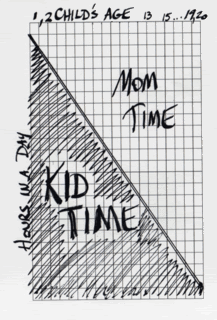
If they're griping and you're ignoring it, that "respect" is not going to last.There's a graph here that's worth considering:
SandraDodd.com/howto
Sandra
I wouldn't put off what needs to be done just because they are resistant.
There's an implication in that statement that they're "resistant" for unimportant reasons, that children's desires and values aren't as important as adult desires and values. It's worth thinking about that. Kids' feelings are intense and immediate and very important to them. Having those reasons poo-pooed as "resistance" doesn't help build communication between kids and parents—it's more likely a set-up for kids throwing out more "resistance" because that's the only way they're feelings are taken seriously.It's more useful to consider *why* the child in question is being "resistant". Is the timing lousy? Maybe mom needs to pay more attention to the ups and downs of the day and time her requests better. I know not to suggest going out to my 9yo if she's in the middle of a project, I look for the pauses and times when she's trying to decide what to do next to suggest an outing.
It's possible, too, that mom's setting herself up by how she's phrasing things—Joyce mentioned that, and mentioned making a statement rather than asking a question and I think its being misconstrued. There's a big difference between "do you want to come do this dull errand with me?" and "let's go get some ice-cream sandwiches!"
Drawing a line between "needs" and "wants" can get very arbitrary very quickly. Is a sense of security a need or a want? Self esteem? Bodily integrity? People *live* without all those things, so they can't possibly be needs—see how fast that gets ugly?In the book, "The Continuum Concept", I gained appreciation for the idea that children should be the satellites of their parents...Step away from that line and see needs and desires, wishes and dreams as all valuable. Sometimes a dream can be bigger than a "need". I've ignored hunger and the need to pee for the sake of my artwork. Not all desires can be met at the exact same moment, for sure, but drawing those kinds of lines can build up resentment and one-upmanship over time. Being gentle with the wants and dreams of the people you love makes for a kinder home, a home in which people—even children—will say "its okay, you go first" out of mutual care. Young children can't always do that in ways that are convenient to adults, but they Do it - they'll give you their special bug to hold out of kindness, or a sticky kiss to let you know you're special. It helps to See those kinds of actions as having value—kids trying to give back to parents in the only ways they understand yet.
Moms' needs and wants, wishes and dreams are as valuable as kids'—and moms absolutely should take care of themselves, but parents have resources kids don't have. They can delay gratification, they can plan, they can see a bigger picture and from others' perspectives. All those adult resources are important in terms of moms taking care of themselves well enough to be able to take care of kids, too.
It's just as important for moms to recognize that One of their needs is to take care of their children. That's important! Seeing that you're meeting one of your needs can help you get by for a time until you can meet others - like sleep. That kind of broader perspective that can make a surprising difference.
Continuum Concept theories are appealing to many people - they were to me, once, but they aren't necessarily compatible with unschooling, and that statement is a good example. My kids aren't interested in being my satellites, they're interested in their own interests.I liked that idea, and I especially liked that it was a concept that native cultures had lived (and succeeded with) for hundreds of years.If your kids are happy to revolve around you and your interests, then Continuum Concept can seem reasonable and sensible, but if they *aren't* content only with your interests, then you're essentially building a kind of curriculum out of your values and preferences. I'm not saying that's a Bad thing, but that the results are similar to other curricula, which is that it frequently becomes something kids endure and set aside at the earliest opportunity.
And that's what happens in a lot of small communities, in small towns and on farms—kids have interests which aren't encompassed by their parents' lives so they get out. Not all kids—because some Do share enough interests with their parents to find the continuation of that lifestyle appealing, but its a personality thing. The Continuum Concept only "works" if your kids have the right kind of personality.
That's a debatable point in and of itself, but the bigger issue in terms of unschooling is that our kids don't live in small, isolated societies with limited contact with the rest of the world—and that's important! What seems to work in an isolated environment will play out very differently when people have lots and lots of options. Generally speaking, parents find that Continuum Concept ideas work when kids are small (sometimes!) but start to break down as they learn more about the world and develop interests and passions different from their parents.If children always get exactly what they want at the expense of others, what will they learn?
You don't have to see your relationship with your kids in adversarial terms like that! If you see what you do for them as a gift, given openly and graciously rather than "at your expense" than kids see generosity and graciousness and value those things—and valuing those things will seek to extend them to others. That's not a guess, its what happens when parents are gracious and thoughtful and kind without fussing over the "expense" of all that care.