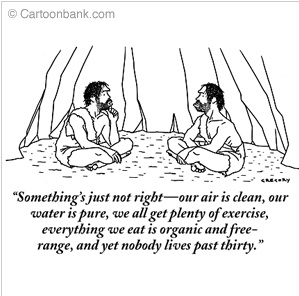
For years, conservative homeschoolers have romanticized Little House on the Prairie (books, TV, fantasy) as the way life should really be, as the way America *was* and as the way their family will live. There was a curriculum, a cookbook, fashion choices.
Below are Brie Jontry's responses to someone's explanation of paleo-dietary considerations expanded to encompass other parenting decisions. Side commentary about Brie's analysis is below.
As for caring for the baby we then looked to paleolithic and tribal peoples for guidance.
Over the past ten years or so there appears to be a resurgence of romanticizing "primitive" cultures, especially in regards to parenting and diet. While one of my favorite things in the world is to sit in front of a campfire and stare at the flames feeling a connection to the people who've come before me and found the same warmth and entertainment in the dancing flames, I think that cherry picking other cultures for their feel-good bits is not only blatantly ethnocentric but also detrimental to unschooling in the modern world. Deschooling on the part of parents, requires an incredible amount of critical thinking. Examining your own culture and that of others is helpful, for sure, but romanticizing something simply because it is the way people did things thousands of years ago will not give you the insights you need to move into unschooling (well).We found that nursing on demand, sleeping with the baby were commonly done and this also worked for us.
Yes, these are wonderful things to bring back to modernity, but they are also things that have never ceased to exist, either. My mom nursed on demand almost 40 years ago and she kept me in a side-car homemade crib attached to her bed. In many of the cultures that people currently attempt to emulate, partially, mothers take extreme measures to push their sons away from the women's enclave at specific ages. Is that something you'd embrace? Slapping your son or turning your back on his cries because he reached five years of age? That might be a necessary (to the survival of the culture) act for some peoples, but is it for you? Would you marry off a daughter as soon as her menses came? Of course not! Would you circumcise a teen? Most likely you wouldn't—why are some things that have been done for thousands of years deemed beneficial to a good life and others not? Just because something is 'old school' (excuse the pun), it doesn't mean it is valuable or indicative of a fulfilling and healthy life.When it came to education we once again questioned the common wisdom of schooling. It turned out that unschooling was the closest thing to how paleolithic children learned.
Paleolithic families had Internet and Netflix and PS3s? Did they have park days and YouTube? Were their parents distinctly turning their backs on the dominant culture and letting them learn in ways that felt kinder and gentler? Were they, in many cases, living at significantly lower income levels so one parent could stay home, at least part-time? Unschooling is nothing at all like paleolithic life.Unschooling is working for our family. As it appears to have worked for countless generation of children.
Unschooling has worked for a generation or two, but it hasn't been working for countless generations. That kind of thinking might get you all bound up in confusion as your son gets older and more aware of the modern world, and it may hinder your own ability to define what it is your family is actually doing.Brie
Schuyler (anthropologist married to an evolutionary biologist) wrote:
Oh, Brie, I know this is outside of the remit of the list, but still, I wish I had a warehouse of posts like Sandra does so that I could save your post for all to see!Sandra:
I'll warehouse it. But under what? Romance? Drama? Logic?Schuyler:
You could put it on all of them, y'know, so that people would be three times as likely to read someone stating that unschooling is more than just living with your kids in a rural idyll, or jungle idyll, without other options.Sandra:
Maybe "reality."
Or "being."Being exists already: SandraDodd.com/being
I will go and create a reality.

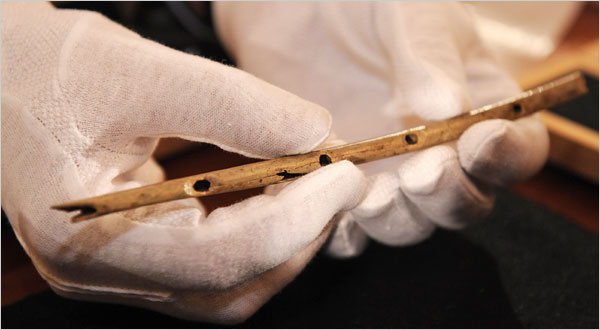
"The Neanderthals, close human relatives, apparently left no firm evidence of having been musical."
EEEK! That quote is from this article, where the flute image was. What kind of evidence might they have left, then? Perhaps like this:
The Saturday Night Live video that was here is no longer on youtube.
It's here, but they don't allow an embed: Next Week in Review, April 22, 1978
If that video is gone, it was an early Saturday Night Live bit referring to Voyager 1's musical offerings to any intelligent life forms that might find it. Wikipedia says:
In a Saturday Night Live segment ("Next Week in Review") in episode 64 of the show's third season, Steve Martin's character, a psychic named Cocuwa, predicts that the cover of Time Magazine for the upcoming week will show the four words "Send more Chuck Berry," which had supposedly been sent from extraterrestrials to Earth the week before.
Brie Jontry:
Unschooling has worked for a generation or two, but it hasn't been working for countless generations. That kind of thinking might get you all bound up in confusion as your son gets older and more aware of the modern world, and it may hinder your own ability to define what it is your family is actually doing.
Sandra Dodd:
The idea that unschooling is the way people learned before school was invented baffles me, too.
Anyone who's read anything about history knows that there were all sorts of ways kids were put to work early, even rich kids—sent to sea, sent to war, sent to fields, went to universities (for the past thousand years+ in Europe), apprenticed out, sold off...
Nobody kept their kids home for 18 or 20 years just discussing life with them, hanging out, playing games.
We probably wouldn't be either, if it weren't that we're biding time until the clock runs out on compulsory education.
So even as we unschool now (and I'm not talking about people with toddlers who aspire to become unschoolers over the years), it's in reaction to the culture around us, it's finding a way to live in an alternative fashion within this culture.
People can't actually leave the planet and can't actually go back in time. The only place we can live is the here and now.
Joyce Fetteroll, on reality and "violent media":
Games are about exploring a world where the rules are different. It's fun to "kill" things in a game *because* it's not real life. In a game you get to do things you can't or don't want to do in real life. In the case of war, you get to experience the strategy of hunting and killing—and being hunted and killed—without having to kill real people, without hurting their families and friends.
Does reading murder mysteries make people want to get away with murder?
Playing a game, reading a book, doesn't change the real life consequences of those actions.
I love the technology of war, always have. All those machines and their powerful and destructive abilities are really cool. But it doesn't make me like what they're designed to do. If there was never a need for another war, that would be wonderful. I have a black belt in Tae Kwon Do. At one point I could have done some serious damage to someone. It didn't make me want to hurt people.
Stacia Reichelt:
My daughter is not old enougn to experience first hand, but my husband has been a gamer all his life and we have many friends whose boys started playing games like Call of Duty and Gears of War since they were 6 or 7. None of them show violent tendencies and all value life - it's one of those instances where adults view the games through a different lens than the children. You won't really know until you let him play, but I have seen no ill effects, especially if it's in an unschooling environment. A lot of people have tried to blame violent crimes and school shootings on violent video games, but in all those cases, the criminals had far more issues going on in their lives.
It doesn't have the smell of war, or the taste, or the feel, or the fear. You get do overs,again and again, as I know first hand. You can change the difficulty setting. All unlike in real war. In real games of tag, even.
You aren't learning to kill, you are solving puzzles and improving accuracy and looking at other people's behaviour in multi-player mode. You are exploring a game and it's boundaries no differently than if you were playing Portal or Minecraft or Terraria.
You kill Creepers and unarmed pigs and sheep in Minecraft. Simon and Linnaea cleared a room of mooshrooms (mushroom cows) and it seemed much more violent than anything they've done in Call of Duty. In Call of Duty you play both sides. You are seeing more readily how arbitrary a side can be. It isn't foreign devils, just other folks, fighting over territory. Particularly on multi-player.
Here's a link to something Deb Lewis wrote called Sympathetic, Empathetic, or Simply Pathetic? The essay is really good, but for anyone hesitant about clicking the link, here's the middle of it as a preview:
My son enjoys television and movies and at times has watched more than the recommended daily allowance for children. He has especially enjoyed adult themed situation comedies and horror films. While he wouldn't select a film just for the graphic violence, he does not avoid them if they are graphic. I would say he is desensitized to horror movie violence in that he is not traumatized by watching fake violence in a made up scenario where no one is actually hurt or killed.Maybe it's just me, but I think that's a good thing. With real world problems ever on the human horizon, fantasy worst case scenarios let us safely ponder our own limits and abilities.
So my son enjoys movie violence, yet he is a person of great emotional sensitivity. He rescues earth worms from the road and sidewalk after a rain. He carries flies and spiders outside so the cats won't catch and eat them. He's gentle and compassionate with our old dog and helps her when she falls down. He has rescued injured birds and mourned over animals killed on the road. He takes committed care of his beloved cat. He gives money to homeless or stranded people when he meets them.
He also does not flinch when Herbert West removes Dr. Hill's head with a shovel in ReAnimator, but he would care very much if a genuine villain were removing the heads of honest to goodness real people in our community....
"But the real kicker is this; choosing to reject all the “conveniences” and “trappings” of modern life is only possible if you’re immensely privileged thanks to all the advantages the modern world brings. Those who swear by their paleo diets, do they grow, find or hunt their own food? Or do they get it from a suitable shop, supported by modern infrastructure? I’d guess the latter."There's more, and it's good.
"keetry" wrote:
I tell people that I'm amazed every day by what my kids know and learn. It seems miraculous. It's not, really. It's normal. I see it as miraculous because I was indoctrinated to believe that none of this could happen outside of school and without teachers.
Teresa responded:
I so relate to this. I was on Sandra's new Reality page recently, and this response, where she is talking about how parents handled their kids' education historically, jumped out at me:
Nobody kept their kids home for 18 or 20 years just discussing life with them, hanging out, playing games.
We probably wouldn't be either, if it weren't that we're biding time until the clock runs out on compulsory education.
This blew my mind. My first thought was, geesh, what else *would* we be doing with them? I had never stopped to consider that unschooling is a product of/reaction to the culture that we all live in, that the time will come when unschooling is irrelevant because the whole concept of education is different. Who knows what people will be doing with their kids in 100 or 200 or 1,000 years? It was very helpful for me to see that unschooling was the *method* that some folks are currently using to allow natural ways of learning emerge in this present cultural moment that happens to privilege compulsory education. It was also fun to think about ways some people have probably always tried to work around or away from whatever system or custom or laws happen to be in place at the time in order to learn what they want in the ways that are best for them.
But! Also, I thought, wow, what a perfect expression of humanity in this day and age unschooling is! We can get our hands on so much information, we can get to so many places, we can access so many people because of this very cool moment in history of the Internet, fairly easy transportation, and enough leisure time (versus time spent focused on surviving) to explore ideas and try skills and make friends and connections.
People have a lot of resources these days, and they are mostly very accessible; of course it makes sense that some of them would seek to use what's available to them when they want it, not just what the schools offer between 8 and 3. It possibly has never been easier to learn about as many different things from so many different sources as it is right now.
I'm with you that what seems to those of us coming from a different paradigm as "miraculous" may well be the most logical outcome of trying to make the most of living in the here and now.
Teresa (treesock) (original)
Related by name, and some lack of reality: Problems with Reality TV
(background for unschoolers who are asked to be on "documentaries")
