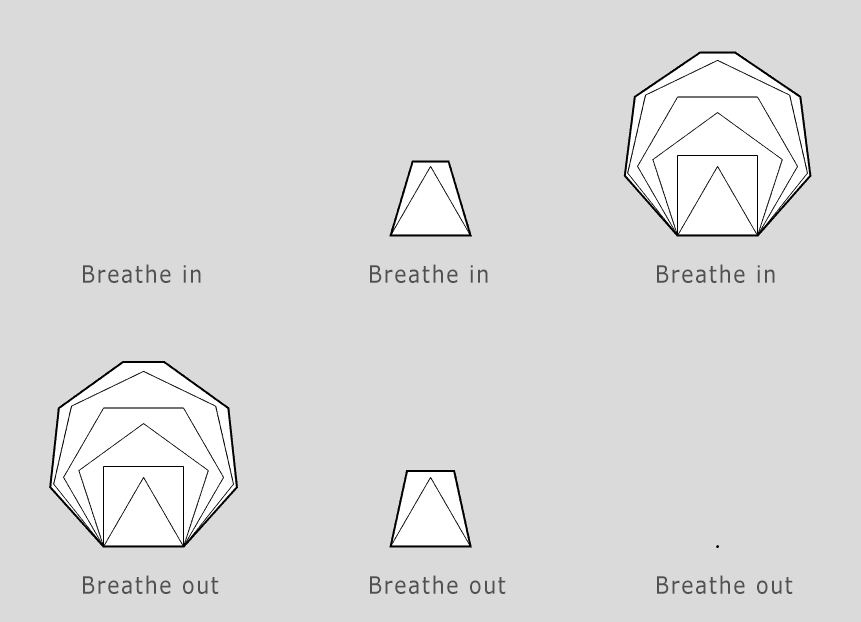
So — there are meltdowns that are angry in nature (there are sobbing sad ones, too, but originally I was referring to an angry meltdown situation). Sometimes they're turned inward or turned towards a bed or a pillow — sometimes they're turned outward toward another person. Meltdowns tend to be an out-of-control explosion.
There's also the kind of hitting/meanness that seems more calculated — "I want this and I'm bigger and so I'll take it." Or "You didn't give me what I wanted so I'll hurt you." But even in those situations, in my experience, there is a bit of an explosion, an inability in the moment to think of what *else* to do, or to see another solution as more beneficial.
The original poster said her son punched her for 15 minutes. The way I saw the interaction taking place, he was out-of-control/meltdown/raging angry. I think it's useful to try to understand that.
To me, there are only limited differences between having an angry meltdown and having an angry meltdown where you try to hurt others. The big difference is that somebody needs to keep the others safe during this time, and get the angry person to a place where he/she can't hurt others.
But past that, there is still the anger to deal with — that's the biggest part of the problem. So here are some thoughts about anger.
One definition I've heard: anger actually stems from helplessness — it's a way to feel powerful when one actually feels very out-of-control and powerless under the surface. Fear and sadness are also often a big part of anger.
Another way to think of it — anger is a way to make yourself big and scary when there's a dispute over limited resources. Not usually a great solution for living in civilization, but it works very well in nature, and the fact that it remains with us speaks for its evolutionary usefulness.
Something else I've heard about anger — when we are infants, screaming and crying are the main tools we have to get our needs heard and met. When things go poorly and our brains shut down, that's what we revert to.
Adrenaline is a big part of an anger reaction — the "fight or flight" reaction is a very difficult one to reason ourselves out of once it hits. In addition to giving us quick reactions and additional strength, adrenaline gives us "tunnel vision" — we are only able to think about, or even see, one or maybe two variables at a moment (as opposed to when our conscious minds function normally, and we can juggle 5-7 variables in a situation).
I hope it doesn't sound like I'm just philosophizing (in a non-helpful way) about anger. I have collected these tidbits about anger because it has played a big part in my own life. It is only in the past few years that I can consistently count on myself to act the way I want to, even when "driven to anger." Knowing these things about anger have helped my own self-awareness, which led to much more peaceful behavior on my part.
Because of my own past, my focus with my children has been to address the underlying issues of anger, and not to focus as much on their behavior as "inappropriate" or "unacceptable," or on them as "abusers." Anger is a difficult emotion to feel, and then when others think that one is a freak or an abuser for feeling a lot of anger, or for feeling it very intensely — that makes it that much more difficult. (I'm still not saying that it's okay for anyone to be abused, and if someone does get hurt, that hurt needs to be dealt with just as much as the other person's anger. I just don't think that it's helpful to put the main focus on the hitting or other abuse, at least in my situation.)
So I think that knowing and understanding something about what anger is can be very helpful for a parent's relationship with their kids and for helping a child with their own self-awareness. It's normal to get angry when you don't get your way. Our brains are set up so that we need to work a little harder at problem-solving and win/win situations — these aren't always our first responses. We can work past that, but we can also have have some understanding and tenderness toward our kids' anger (and our own).
I also think that knowing how narrowly focused the brain gets when angry does highlight the need for giving information. People get very self-absorbed when they're feeling angry and needy. As well as dealing with the needs themselves, when the child is in a better frame of mind, the parent can point out things that the child may not have considered. "It's not fun for me when you're fighting at the grocery store."
But all that information often can't be heard if the a person is still in angry mode or "fight or flight" mode — adrenaline doesn't make enough room in the brain for any more information or talking at that point. That information tends to be more helpful before a situation arises, with some forethought as to what might arise before it does. It's also more helpful afterwards, when the child is calm and has a chance to re-think the situation. (Of course, giving information in a direct, condensed form in the middle of an angry situation can sometimes help the person re-focus. "That hurts, so stop." "Your voice is hurting my ears." "If you throw that it will break, and you won't have it anymore.")
At my house, we do have a word for that before-and-after talking and thinking — we call that processing. Or briefing and de-briefing — I've heard it called that, too. There was some talk about the word, "processing," on the list, too, with some unpleasant examples/associations of the word — all true. I do have another view.
Processing is also what a computer does to information, breaking it down into binary information that it can work with. We process grain in a mill and then in an oven — breaking it apart, taking out the hard unhelpful parts, and cooking it with other things so that our bodies can swallow and digest it.
Digestion itself is a process, and through it our cells get the fuel and nutrients in a form they can use them — and our bodies get rid of the crap we don't need in the same process.
I wouldn't want to process people, but I think processing ideas and emotions and one's understanding of a situation can be pretty useful. I usually need to do it quite a bit, for my own peace and understanding.
I just would never force anyone else to join me in the process or to go through it themselves if they weren't ready. That causes stress, and as we all know, stress doesn't aid digestion — of food or ideas — well at all.
(at Unschooling Discussion, July 2005)
Adrenaline is a big part of an anger reaction — the "fight or flight" reaction is a very difficult one to reason ourselves out of once it hits. In addition to giving us quick reactions and additional strength, adrenaline gives us "tunnel vision" — we are only able to think about, or even see, one or maybe two variables at a moment (as opposed to when our conscious minds function normally, and we can juggle 5-7 variables in a situation).I'm responding to myself here🙂, but if as I look more at the adrenaline reaction with anger, that really does give a *lot* of useful information about how to help someone who is approaching this reaction or is in the middle of it.
—Breathing deeply helps our cells get oxygen and flush out the chemicals (hormones) associated with an adrenaline reaction.And as far as what not to do:
—Drinking liquids helps the cells flush out the adrenaline itself.
—Eating protein helps the conscious, problem-solving part of the brain wake up and start working again.
—Sleep restores our ability to make judgements and problem-solve as well.
—Changing the environment —-removing the thing that the angry person is fixated on helps relieve the tunnel vision problem.
—Trying humor or something pleasantly surprising can get the conscious mind working again and over-ride the anger response.
—Giving needed information in a quick, calm and direct form has the best hope of getting through.
—Physical restraint of any kind does somewhat heighten the "fight or flight" response. In this mode, the angry person trying to beat down resistance — even someone holding up their hands to ward off our blows. If we feel a physical resistance of any kind, that's a signal to the body that we need *more* adrenaline, and to fight harder.We talk about these things a lot on the list—I just like having an organizing concept that ties them all together like this. I've always been one of those people that needs to know why.As I think about it, that may explain why [the original poster] had to hold her hands up for 15 minutes — a really long time — to protect herself against her son. She needed a different strategy that didn't send a signal for *more* adrenaline.—Excessive talking just increases the fear and confusion — lots of information and my poor little monkey brain (at the moment of anger) can only focus on one thing. At best, lots of talking is useless — at worst, it's confusing and adds stress.I think there are times we have to physically intervene, and it's better than nothing if someone's going to get hurt, but it makes sense why it needs to be a last-ditch effort.
—Yelling in a threatening tone just increases the adrenaline response. Adding anything to the environment that would be perceived as a threat or that causes pain may only add to the response.
—Sensing fear in others might add to the adrenaline response, much like in dogs and horses, I think. The over-focused brain picks up on the fear and figures that it might mean another threat — "maybe I should be afraid, too."
Maybe others can add things or offer other considerations to this list.
I'm hesitant to send this because it might be too obvious and spelled-out, but it might help others to put it all together, too.
(near the bottom here)
Yesterday Linnaea had a friend over, whenever this friend is over there is usually a huge creative mess that explodes over one room or the other. Last week they made flour art, I redirected them from the bottom of the stairs to the sunroom, which is much easier to clean and much less likely to get tracked through the rest of the house. It would have been easy to get angry and to stop it all together with resentment on all sides, but flour is a pretty cool medium and I found some dark paper that they could "draw" on and they had a blast creating temporary art. Often their art has water involved, and toilet paper. They love creating homes for their Littlest Petshop pets that include water and toilet paper.
Anyhow, that isn't my story, that is just the background piece to demonstrate the mess potential. My story is about me and choosing in a moment what I wanted to do with my emotions. Linnaea and her friend had been up in her bedroom for ages, quietly and not so quietly playing. They were having a blast, telling stories with the toys that I've managed to unpack (quite a few toys) and playing on her bed. I'd asked her to go sparingly on the toilet paper as we were down to the last roll (or 2) and with the runny nose she was suffering from, well we needed all the toilet paper we had at that moment.
I was downstairs unpacking a box or two with Simon trying to find the beyblades he wanted and found a couple of dolls to bring upstairs. When I got there I found that all the stuffed animals, all the dolls, everything had been pulled off the shelves and scattered onto the floor. She has a lot of stuffed animals. It was a big pile of mess. And my first reaction was anger. I was mad that all the work I'd done to put those animals on the shelf had been wiped away in whatever amount of time it had taken for these two little girls to take them all of the shelf. But I didn't express that emotion. I went downstairs and I sought out David and I talked out how I was feeling with him. And I said "I don't have to clean it up." and I said "It isn't even my room." and I breathed and I let it go.
Today I went upstairs to vacuum and to put clothes away. When I went into her room to put some clothes in I looked around at the stuffed toy apocolypse and realized it was pretty cool. There were stories all over the place. There was a gorilla with a puppy sitting together in the closet which reminded me of Koko the gorilla and her kitten which resulted in me looking on-line for images of Koko with All Ball and having a conversation about sign language and gorillas. There were moments all over her room that told of how their stories were woven. And it was my pleasure to go through and pick up the toys and put them away so that the next time she and her friend get together they have a clean slate. I got to chose how I approached that mess, that tension, that horrible room. And by breathing and thinking and choosing I got to have that moment where I found the gorilla and the puppy and have it become Koko and her kitten. And now I know Koko is moving, again.
Another story from yesterday. I was tired and ready to go to bed. Linnaea had discovered Daredevil was on and she offered it to Simon. Simon got excited and sat down to watch it. Linnaea wanted to watch with him. I wanted to go to bed. So, I went upstairs to get ready. And while up there I was thinking about how scary Daredevil might be for Linnaea and that I would just be lying in bed waiting for her to come and join me and that I could do that kind of relaxing with her sitting on my lap just as easily as up in bed. So I got my pajamas on and went back downstairs and we watched for a few minutes and then they both decided that they didn't want to watch the whole thing. But she was so pleased that I had come down to join her. She beamed at me. That was worth a lot of feeling sleepy.
If you are nervous about him being alone with scissors could you set up a nest for yourself in the living room so that you can nod off a bit while he creates. It helps to think of the solutions instead of the obstacles. I'm not always brilliant at it, but I am getting much better at catching myself before I say something negative or mean or limiting. And because of that, because of my willingness to say yes, when I am too tired or need to have something happen, Simon and Linnaea are much, much more willing to accommodate my need.
Schuyler
March 2008 (Linnea had just turned eight.)

Parenting During a Meltdown (Robyn Coburn)
Soothing a Frustrated Child (Pam Sorooshian)