It can feel good to begin to understand the idea that there are other intelligences than verbal and mathematical, though. For those trying to understand themselves better, these ideas can be soothing and illuminating. Gardner wrote
"Knowledge is not the same as morality, but we need to understand if we are to avoid past mistakes and move in productive directions. An important part of that understanding is knowing who we are and what we can do... Ultimately, we must synthesize our understandings for ourselves."
Some of the information above quotes from Dr. Thomas Armstrong's site. Because that site is so pro-school and traditional, though, I don't recommend it as a primary source of understanding multiple intelligences in the context of unschooling. His site was linked but is gone now; sorry.
Howard Gardner's original list included seven intelligences. Two are those are measured at school. Three are arts and sports. Two are "personal intelligences." Then an eighth was added that isn't in any of the categories above.
Linguistic intelligence involves language use and understanding. It's not about multilingualism, though some people have a talent for learning other languages. Talent in one's own language is linguistic intelligence. Writers, poets, witty conversationalists, those who can win arguments or inspire others with words, or those who can learn well from ideas expressed in words (heard or read) are all showing linguistic intelligence.A "kid-level" version of these isLogical-mathematical applies not just to straight-out numbers, but to seeing and thinking in patterns, and of being scientific and analytical. Clarity of thought is logical/mathematical as surely as being a numerical whiz is.
Musical intelligence doesn't need to apply only to accomplished musicians. Appreciation and understanding of music, being moved by music, hearing tones and rhythms, as well as the ability to compose or create music fall into this category.
Bodily-kinesthetic covers dance, body-awareness, physical talents that might be used for sports or knot-tying or wood carving or physical therapy. Some people are only slightly aware of how their bodies work and what their capacities are. Some people seem to be born knowing, or using their bodies well without even thinking about it.
Spatial intelligence—what's where, how far away, how does it fit together? Those who can solve physical puzzles or put things together that have fallen apart are probably high on this scale. Gift wrappers who can spot the right size of box and wrap it beautifully might not have considered it a special intelligence.
Interpersonal intelligence is about understanding other people—their non-verbal expressions, their motivations and desires and moods.
Intrapersonal intelligence is understanding one's self in those ways. How are you feeling and why? What are your capabilities and problems and fears and what will help you move toward goals?
Naturalist intelligence involves recognizing and categorizing things. Birds and clouds, certainly. Trees. But it also applies to flags, heraldry, automobiles, computer components... the talent for recognizing a widget or a seed seems to be the same.
Existential intelligence, or spiritual intelligence—This is under consideration and being discussed, but not fully accepted by Gardner and others yet.
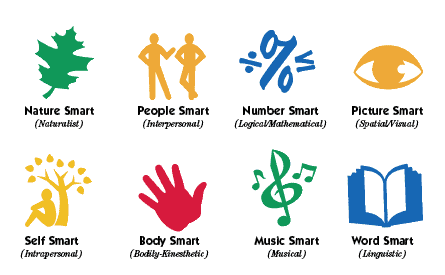
word smartwhich are used by Thomas Armstrong in his book You're Smarter Than you Think, and other places. "Picture smart" doesn't seem nearly sufficient for the 3-D modelling involved in spatial intelligence, though.
logic smart
music smart
body smart
picture smart
people smart
self smart
nature smart
With google, I found some graphic representations of the intelligences.
The best, by far, is from a site called Learning and Teaching by James Atherton, who has had (?) an extensive site about learning (including such ideas as "Teaching" as an activity does not exist...")—anyone interested in how learning works should visit there. [The preceding link goes to the internet archive, and you can see more of that site there, too, as it once was.]
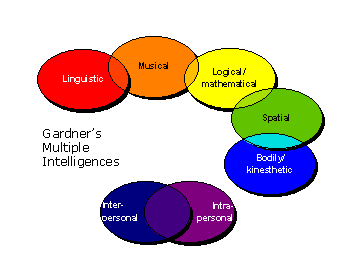
Strong National Museum of Play in Rochester, New York had a display and a class or workshop about this, and here's their chart:
There were a couple of dozen different representations and there will probably be more when you find this. Try this link: Multiple Intelligences, image search
Verbal/Linguistic


A couple decades ago, Howard Gardner, a professor at the Harvard Graduate School of Education, developed the theory of multiple intelligences. In a nutshell, he proposed that there is not a single "intelligence" but seven. Those are:
Visual/spatial intelligenceMore recently, he added an eighth intelligence to the list, naturalistic. For decent descriptions of these intelligences, see the list here. [It's gone.] His theory has been accepted through most of the educational community and is taught to many aspiring teachers, but it has been put in practice in only a very few schools around the world. Instead, most schools continue to value and reward verbal and logical intelligences and are geared toward those.
Musical intelligence
Verbal/linguistic intelligence
Logical/mathematical intelligence
Interpersonal intelligence
Intrapersonal intelligence
Bodily/kinesthetic intelligence
With unschooling, kids aren't all expected to have the same sort of intelligence. Verbal and logical intelligences aren't valued more, so kids with other intelligences aren't at risk as they are in school. For example, a boy with kinesthetic intelligence might be a discipline case in school, or labeled with dyslexia or ADD, or simply made to feel stupid. As an unschooler, that same boy might learn his ABC's while jumping on the trampoline, start reading while playing video games, or simply and beautifully excel in some physical pursuit. Most importantly, he will never be made to feel he's less for being who he is.
Learning styles go hand in hand with multiple intelligences. Gardner says, "Styles refer to the customary way in which an individual approaches a range of materials—for example, a playful or a planful style." With unschooling, we are able to honor our children's learning styles as well as their intelligences.
For example, the verbal intelligence of both of our girls is indisputable, but Chloe's learning style is playful and verbal, while MJ's is more thoughtful and internal. What I think of as their "secondary intelligences" are different, too, with Chloe's logical and intrapersonal leanings and MJ's musical, visual, and interpersonal ones.
So, what does honoring their learning styles and intelligences look like? In Chloe's case, it often looks like conversation! She lights up when we talk, and her experience of anything, whether it's a book or a dream or a trip to the grocery store, isn't complete until it's discussed and, usually, laughed over. She has always been this way. I remember hiring a nanny years ago, long before unschooling, and telling the nanny that Chloe needed to be listened to. We made it a job requirement.
Then there's her sensitivity. She feels hurts very strongly and has had periods of intense awareness of cruelty, hypocrisy, ageism, and, repeatedly, her own isolation from others. (This last is not about social isolation but an understanding that she is alone in her own brain, if that makes sense.) Honoring her intrapersonal processes and periods of grief has required patience, gentleness, and a certain creativity in finding ways to comfort her.
In MJ's case, the honoring often means butting out, something that can be especially challenging for me! She is very independent and very skilled at telling us what she needs, so we really can take our cues from her. Her goals tend to be thought through and well defined, and her pursuit of those goals is deliberate and self-monitored. She's more disciplined than I am, but she never nags, so I too often find myself in the position of holding up her progress because I've procrastinated and then forgotten something she needs me to do. In other words, honoring MJ's intelligence and learning style means daily work on my own faults!
Her study of music and interpersonal relationships has also presented some challenges. As you may have gathered, I hold strong opinions. As MJ has explored the offerings of the music world, I have had to repeatedly reexamine those opinions and tap into my trust of her. Eminem presents one good example. She was about 10 when she wanted to buy her first Eminem CD. "Absolutely not" was my first response, but I had to check that. We had conversations about his lyrics, their potential encouragement of violence against women, and my fears that her listening to his music would change her in negative ways. Then she got her CD. We had more conversations about specific lyrics, but I learned to appreciate some of his music; I didn't see any change in her language, behavior, or self-esteem; and, with all parental disapproval removed, he proved to be just one stop in a long and varied musical journey.
Another example was a TV show she started watching not long after we started unschooling. Its title was something like "I'm a Celebrity, Get Me Outta Here," and it involved plopping several B celebrities into a primitive camp in the jungle to see who lasted the longest. I found it loathsome, especially the flirtatious antics of one "blonde bimbo" on the show, but I was encouraged by other unschooling parents to watch it with MJ and try to see what she found so interesting. That was when her fascination with interpersonal relationships became clear to me, and it wasn't long before I was as hooked on the show as she was. And the blonde turned out to be a sweet young woman, so I got to confront another of my own prejudices.
Because their strengths coincide with strengths valued by the schools, I have little doubt that MJ and Chloe would have excelled and been reasonably content had they stayed in school, and they'll be able to slide back in easily if they ever choose to return. But the thing is, they haven't needed school to develop the skills valued by school. Their interests, inclinations, and abilities have led them to a natural expertise.
Think about that. The kids who do best in school, who have the types of intelligences that schools are geared toward, are going to excel in those areas without ever setting foot in a classroom. So all they really get from school is gold stars and A grades for doing what comes naturally.
And what about the kids who struggle in school? They spend all those years feeling inadequate. Yes, some of them learn to write well, or to enjoy reading, or to do some higher math. But can the schools take the credit for it? After four years of unschooling, I'm not convinced they can. Maybe it's another case of a natural process coinciding with an artificial one. And for every one of those kids who is able to adapt himself and get the rewards of school, there is one (five? twenty? a hundred?) who comes out of school with nothing but a self-esteem problem. It's thirteen wasted years, years he could have spent in an environment that valued the strengths he possesses, developing real skills to build a life on.
Well, I've digressed into a critique of school, which wasn't my intent. I suppose my hope when I started writing this was to encourage people to recognize that we don't all fit into the school mold. For those who don't fit the mold, consider unschooling or other customized education as an alternative to criticism, shame, and prescription drugs. The academic results might be equivalent or better, and the psychological benefits, immeasurable. For those who do fit the mold, school offers little but validation.
Katherine Anderson (~Katherine), responding to the following comment on the Always Learning list, September 2010:
Sometimes parents get stuck there, though—reading stories like this and thinking "that's not my kid, guess I can't unschool math." It isn't true, but it takes a little more trust and understanding about natural learning.Not everybody needs to know math beyond arithmetic and children may not find much use for it until later on. Understanding natural learning means seeing that children pick up things as they find use for or have interest in them.
"Everybody is a genius. But if you judge a fish by its ability to climb a tree, it will live its whole life believing that it is stupid." ~Albert Einstein
Each individual can do or be something which, if it doesn't amaze people academically, is too often seen as worthless. Sometimes that's the ability to see or hear or say things in a unique or unusually keen or apt way, or to do kinetic feats with greater and greater skill or for some cool purpose, or to interact with people or animals or nature or ...
To see children through school eyes is like continually longing for a fish to climb a tree. It's a view that insists on an improbable future or that looks mostly for a child's potential, perhaps never able to enjoy the present moment.
To see children as they are is to have the capability to enjoy them now. Without that view, I think unschooling is hard or impossible.
When your child isn't good at something academic or something most people in your family are good at, remember that not all your peers are good at that either. Which simply means that people are different ...
Some children can use numbers easily but not all children can. Some adults
can use numbers well ...
Some children are good with people but not all children are. Some people are
good with people ...
Some children are adept at making up stuff but not all children. Some adults
are into make-believe ...
Some children adapt well to or love changes and new situations but not all
children do. Some people like anything new ...
Some children take well to swimming; others not as quickly or as well. A few
individuals are even deep sea divers ...
Some children think or read or write or draw or paint a lot. Others do other
things.
~Katherine
here