
Online game to play free and there are other games there, too, at CrazyGames.
|
This is one of the oldest pages I have, and years ago it was one of the few snakes and ladders resources online. I got e-mail asking for more info, but now (2024, is when I'm editing this page in hopes it can work on phones), there is a Wikipedia page! |

They also have had one from the turn of the century (not THIS century, 19th to 20th) with
cats, which I own as a piece of wrapping paper (now laminated). Their name for it was "Miaou Miaou c1900."
The game is Hindu and was used to teach children about the religion in that the good squares allow a player to ascend higher in the league of life whereas evil will reduce a player back through reincarnation to lower tiers of life. Presumably the last square, 100, represents Nirvana.The virtues (Hindu) are named there, and some of the English substitutions.The morality of the game must have appealed to the Victorians, who took to the game when it was published in 1892 in England. Called Snakes and Ladders, the game play was pretty much the same but some of the vices and virtues were renamed according to Victorian ideals.
Board Game Geek has a page on this game, and just about every other boardgame you could think of.
Here's a comment on the back and forth direction:
Because books were mainly read out loud, the letters that composed them did not need to be separated into phonetic unities, but were strung together in continuous sentences. The direction in which the eyes were supposed to follow these reels of letters varied from place to place and from age to age; the way we read a text today in the Western world-from left to right and from top to bottom-is by no means universal. Some scripts were read from right to left (Hebrew and Arabic), others in columns, from top to bottom (Chinese and Japanese); a few were read in pairs of vertical columns (Mayan); some had alternate lines read in opposite directions, back and forth-a method called boustrophedon, "as an ox turns to plough", in ancient Greek.Yet others meandered across the page like a game of Snakes and Ladders, the direction being signalled by lines or dots (Aztec).Though their comment was to be that Snakes and Ladders goes up, down and all around, the way the numbers are set on the board, that's "boustrophedon"—as an ox turns to plough—to the right, then to the left, then to the right... (sample of boustrophedon writing)Alberto Manguel, Chapter 2 of A History of Reading (New York; Viking, 1996). The Silent Readers
The article writes about the history of the game, in India, and is illustrated with one English board and two from India. The article is by a professor in Kolkata, in 2020.
Museum of Childhood, a division of the Victoria & Albert museum, has images of several such games.
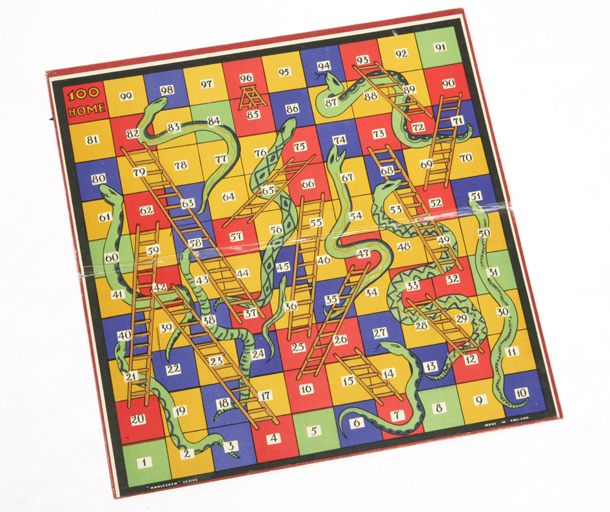
Victoria and Albert Museum had a page up for the year of the snake: 
I was recently looking up the history of one of my beloved games Snakes & Ladders when I came across your website.
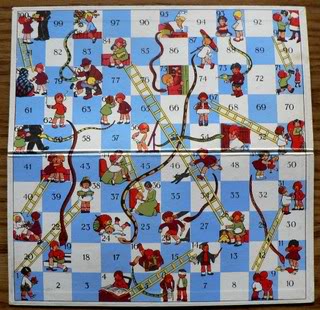
I am sending you a photo of a snakes and ladders game that I own. From the type of materials used to make the board I don't think it is older than around 1970 but I do love the graphics because they are probably a reproduction of an original board which to me looks likes a style from the 1920's or 1930's. On the back it looks like the game parcheesi but there are no marks or writing to indicate who made the board or when.
Its especially nice because it carries the Victorian idea that you mention about vices and virtues. You'll notice some of the photos-16
for example where the two boys are wrestling and the snake takes you to 6 which show them both with injuries.
I also love 62-the boy is smoking and the snake takes you to 19 and shows him sick. My daughter and I have played this game since
she was around 4 years old (she is now 15) and we love it!
Hi Sandra,
Thanks for your web page! I found it by chance as my husband and I were trying to find an on-line snake and ladder game. It was a great surprise for me as I recognised the snake and ladder board I used to play with twenty years ago when I was a child: the sleds and toboggans. Actually, this board had belonged to my great-grand-mother, and had been kept since then by my grand-mother. As a 10-year-old child, I marvelled at the thought I was playing with a game my great-grand mother used to play with at the beginning of the century!
I suppose the board must be still at my grand mother's house. I am definitely going to check this. Anyway, finding your page was a nice Proust's madelaine, so thank you.
regards
Armelle Grévellec
(January 2011)

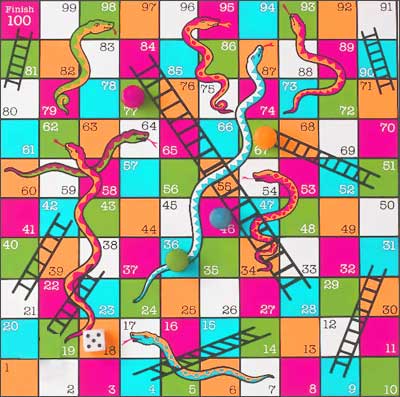

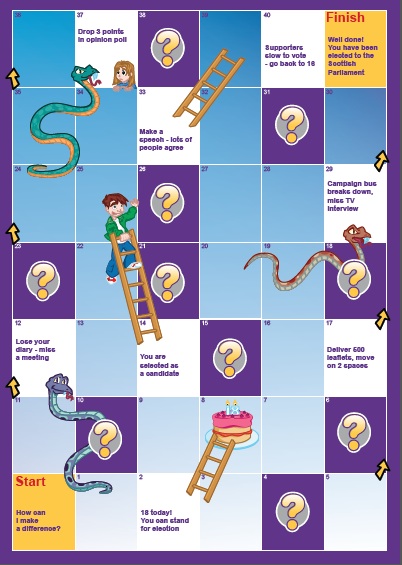
(printable, free; click to get to the very large version)
(Contains Scottish Parliament information licensed under the Open Scottish Parliament Licencev1.0)
Those links were gone, but I found archives, AND a Gaelic version!
There are question cards, too, in English and Gaelic.
Parama Pada Sopanam means Steps to the Highest Place (where Parama Pada means highest place and Sopanam means steps). This is a traditional version of the popular game of Snakes and Ladders. The game was believed to be symbolic of a man’s attempt to reach God. The ladders represent virtues and the snakes represent vices. The snakes carry names linking them to stories from our epics.
This game is suitable for two or more players of all ages.
Other Names: Snakes and Ladders, Moksha Padam, Gyan Chaupar
