Jo Isaac, new in 2017:
Scientific studies show that humans habituate to food — such that, for example, the 10th bite of of chocolate is less desirable than the first bite. In scientific terms, habituation is the "decreased physiological and behavioral response due to extended or repeated exposure to a stimulus." So, essentially, the more you eat something, the less you want to eat it.
Habituation is so strong a force, that even thinking about eating a certain food can decrease your motivation to eat it. For example, in a study in 2010, people who were asked to imagine eating 30 M & M's ate fewer M & M's compared people who were asked to imagine eating 30 cubes of cheese, and vice-versa (Morewedge, Huh & Vosgerau 2010).
The researchers concluded that the resulting decrease in eating that food is because the participant desired to eat it less, not because they considered it less palatable, or that they felt full.
This study also shows that habituation to a food is food type specific (for example, M & M's only, not cheese).
This study, and others also show that habituation works equally for sweet and savoury foods — so you get habituated to M & M's just the same as cheese. Another study compared habituation rates between apricots and chocolate cake and found consumption of both declined to the same low level over the same time period.
And in case you were wondering, while most studies use adults as subjects, the same habituation response has been found in children repeatedly presented with apple pie and hamburgers (Epstein et al. 2003).
In unschooling terms, the science is clear — the more M & M's your child eats, they less they will want M & M's. Which explains nicely why halloween candies are often left uneaten by radically unschooled kids, while they go looking for a grilled cheese sandwich or some fruit.
Carey K. Morewedge,Young Eun Huh,Joachim Vosgerau. Thought for Food: Imagined Consumption Reduces Actual Consumption, Science, 2010, Vol 330, 1530-1533
Epstein, Leonard H., et al. "Habituation of salivation and motivated responding for food in children." Appetite 41.3 (2003): 283-289.
Habituation
In response, in part, to those people who say "If I let them, all they'd eat is....(insert food—chocolate, candy, cheese, bread, etc...)."
For a similar analysis from another science, see "Economics of Restricting TV Watching of Children", by Pam Sorooshian, an unschooling mom and economics professor (retired now). The examples involved food.
Dr. David Waynforth, an unschooling dad and a professor, in 2009, wrote an article inspired by reading Pam Sorooshian's article, and other research:
"Evolution, obesity, and why children so often choose the unhealthy eating option", Dr. David Waynforth, 2009
A summary of some recent-ish research on the effects of parental food control on children's eating habits:
In an extensive review paper in 2004, Benton assesses the role of parents in the determination of the food preferences in their children. He explores the evolutionary basis behind children's food choices—for example, babies and toddlers have an innate preference for sweet and salty flavours and avoid bitter and sour tastes. This is explained as reflecting an evolutionary background where sweetness predicts a source of energy, whereas bitterness predicts toxicity/poison.
He also discusses the evolutionary mechanisms that might explain why children avoid new foods (termed neophobia), particularly in toddlers. In our evolutionary past, avoiding new foods had survival value if it discouraged eating items that might have been poisonous, particularly at the stage when a child was beginning to walk. Benton stresses that "Parents need to understand that neophobia is normal."
He then goes on to examine parental manipulation of food, and finds:
Berge summarises that the research indicates that authoritative parenting style is positively associated with child and adolescent obesity.
On the other hand, the research shows that measures of family closeness and connection predict healthier food intake, lower family conflict, lower parent-child conflict specific to eating, and lower rates of emotional distress for overweight males and lower rates of extreme dieting among overweight girls.
In a more recent paper, Janzen et al. (2012) also found that the research shows that restrictive parenting could stimulate poor intake regulation and overeating at times when access to food is not restricted, resulting in weight gain. While Rodgers et al. (2013) state that restriction, emotional feeding, encouragement to eat, weight-based restriction and fat restriction were associated prospectively with the development poor eating behaviors in children including emotional eating and tendency to overeat.
Links to full access papers:
Benton (2004) Role of parents in the determination of food preferences of children and the development of obesity.
(link)Berge (2010) A Review of Familial Correlates of Child and Adolescent Obesity: What has the 21st Century Taught us so Far?
(link)Jansen et al. (2012) Children's eating behavior, feeding practices of parents and weight problems in early childhood: results from the population-based Generation R Study.
(link)Rodgers et al. (2013) Maternal feeding practices predict weight gain and obesogenic eating behaviors in young children: a prospective study
(link)
I think, from an evolutionary perspective, it makes sense that kids are generally likely to choose from a limited pool of foods that they are familiar with, and often those don't include leafy green plants — for good reason....Thyme to touch: Infants possess strategies that protect them from dangers posed by plants
There is also some research that suggests that some veggies have chemicals that inhibit rapid cell division. That's OK for adults and may be one way vegetables can protect adults from cancer, but not OK for fast growing children...
As a child I ate only a few foods, and slowly as I got older (not until my 20's) I expanded the range of foods I ate - in my own way, in my own time
Find what your kids like, and buy more of it.
Note from Sandra: in case that link goes bad someday, here's enough to search for it elsewhere:Thyme to touch: Infants possess strategies that protect them from dangers posed by plants
Annie E. Wertz, Karen Wynn
Department of Psychology, Yale University
David Waynforth found this article, and Schuyler Waynforth sent it with this note:
It's about how children's reticence to eat certain kinds of things might be adaptive given the foods that would have been around in hunter gatherer's larders. In the conclusion section [the author] says:
Parents are often advised—with good reason—to relax about their child's eating behavior and not worry so much. Yet this is often difficult for them to do. If it can be shown that these behaviors are sensible adaptations to learning about food, parents should be better able to accept their child's food habits with equanimity.Schuyler
Adaptiveness of food learning and food aversions in childrenClicking the title just above the abstract will take you to a page that says [PDF] from researchgate.net. Clicking THAT (on the righthand side) will open a PDF you can read (or it did on my MacBook, anyway), and it downloads it (which you don't need to save, if reading it on the screen is plenty). It's about a dozen pages plus citations.
Elizabeth CashdanAbstract
This paper uses an evolutionary perspective to explain features of food learning in human children. Data from Western parents indicate that (1) children are least picky about foods when they are between one and two years of age, (2) vegetables are frequently refused by children, and (3) children have a tendency to eat foods one at a time rather than mixed together. Adaptive explanations for these patterns are suggested, together with supporting evidence from studies of the ontogeny of human and non-human primate diet choice. The following arguments are made: (1) age difference in receptiveness to new foods is consistent with the existence of a sensitive period for learning about food; (2) since leaves and other non-fruit plant parts often contain toxic secondary compounds and young animals are less able to detoxify these chemicals than are adults, an initial dislike of vegetables may function to protect young children against the risk of poisoning; (3) a preference for easily identifiable foods eaten separately may be an evolved preference that aids in identification of the food and the consequences of eating it.
Here is a summary of the book:
Let
them Eat Cake: the Case Against Controlling What Your Children Eat.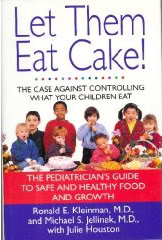
Pediatrician Klenman and child psychiatrist Jellinek believe that too
many well-meaning parents take food and rules far too seriously for a
child's own good.
While the food choices children make are sometimes dreadful, parents should not act as food police. Instead, all would do well to place food choices in proper perspective: children are not middle-aged people, their nutritional needs are different from adults', food is (usually) not a life-and-death issue for them, and one or two not so nutritious meals will not hurt them. Therefore, suggest the authors, kids shouldn't worry about cholesterol or feel guilty because they enjoy a candy bar.
Although some parents may believe otherwise, these doctors declare studies have shown that banning sweets is counterproductive. Children, they say, should be offered choices and encouraged to try new foods. This is a sensible, well-written and unhysterical approach to what some may consider a parental nightmare: children who have minds of their own when it comes to food.
In addition to questions most often asked by parents, the authors also provide in-depth discussion of food safety, food allergies and eating disorders.
-pam
on AlwaysLearning, November 2008.
Silvia Scaglioni*, Michela Salvioni and Cinzia Galimberti
Pediatric Clinic S. Paolo Hospital University of Milan, Milan, Italy
They're not unschoolers, but they're not proposing total parental control, either. They do say that limits create desire and pressure creates aversion. There are things unschoolers can use, and some thing that might seem more controlling than necessary.
